Return on Ad Spend (ROAS) has long been one of the most discussed and sometimes misunderstood performance metrics in digital marketing. For some businesses, ROAS is viewed as a straightforward metric: the higher it is, the better. Targets of 5×, 6×, or even 10× are often set without much consideration for what those numbers truly represent in terms of margins, scalability, or sustainability.
The reality in 2025 is far more nuanced. Rising advertising costs, increased competition, and the growing dominance of digital platforms have made it clear that a “good” ROAS does not always need to be exceptionally high. For small to mid-size e-commerce companies, travel service providers, and experience-based businesses, a healthy and sustainable ROAS often falls between 1.87× and 3.6×.
This range may appear conservative at first glance. Still, it reflects the economics of sustainable growth in competitive industries where building long-term customer relationships matters more than chasing vanity numbers.
Understanding ROAS
At its core, ROAS is straightforward:
ROAS = Revenue Attributed to Advertising ÷ Advertising Spend
A 2× ROAS indicates that every $1 spent on advertising generates $2 in sales.
A 1× ROAS means a business is breaking even on ad spend, covering costs but not generating additional return.
Anything beyond that depends on industry norms, margin structures, and how well a brand leverages its customer base.
The key takeaway is that “good” ROAS is context-dependent. It must be measured against the broader financial model of the business, not in isolation.
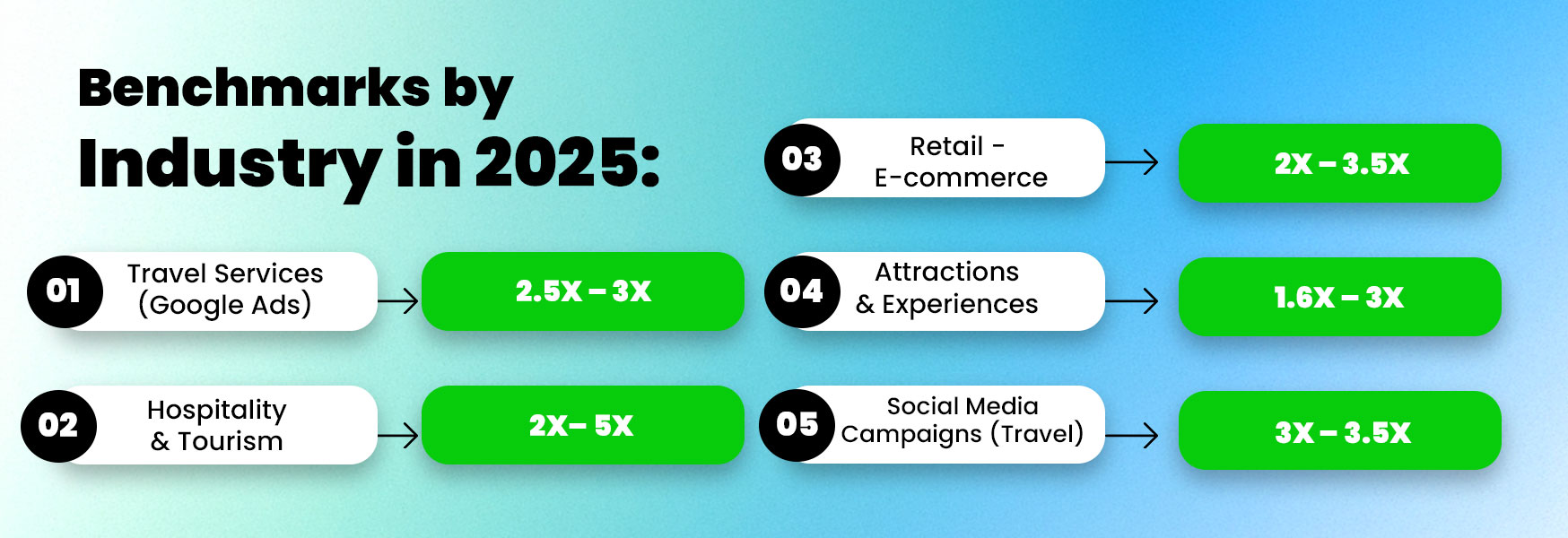
Industry benchmarks provide useful context for evaluating performance. According to leading reports, average ROAS in 2025 varies significantly across verticals:
These numbers demonstrate that most businesses will not achieve 6× or 10× returns consistently. Instead, a 2× to 3× ROAS is not only normal but often a strong indicator of health and competitiveness.
The Aggregator Challenge
Independent businesses, particularly in tourism and local experiences, face a unique challenge: competing with large-scale aggregators such as GetYourGuide, Viator, and Klook.
These companies dominate digital visibility across search, social, and mobile. With significant capital at their disposal, they can afford to spend aggressively on advertising, often at a short-term loss. Their strategy is based on market capture rather than immediate profitability.
For small operators, attempting to replicate this approach is neither feasible nor advisable. The path to success lies in focusing on areas where smaller businesses hold an advantage:
Owning and leveraging customer data rather than relying on rented traffic
Building retargeting audiences for efficient follow-ups
Reducing dependency on aggregator commissions
Establishing direct, repeatable sales channels that increase long-term profitability
When these foundations are in place, even a 2× ROAS can be highly valuable because it reflects sustainable, owned growth.
Why 1.87× – 3.6× Is a Strong ROAS
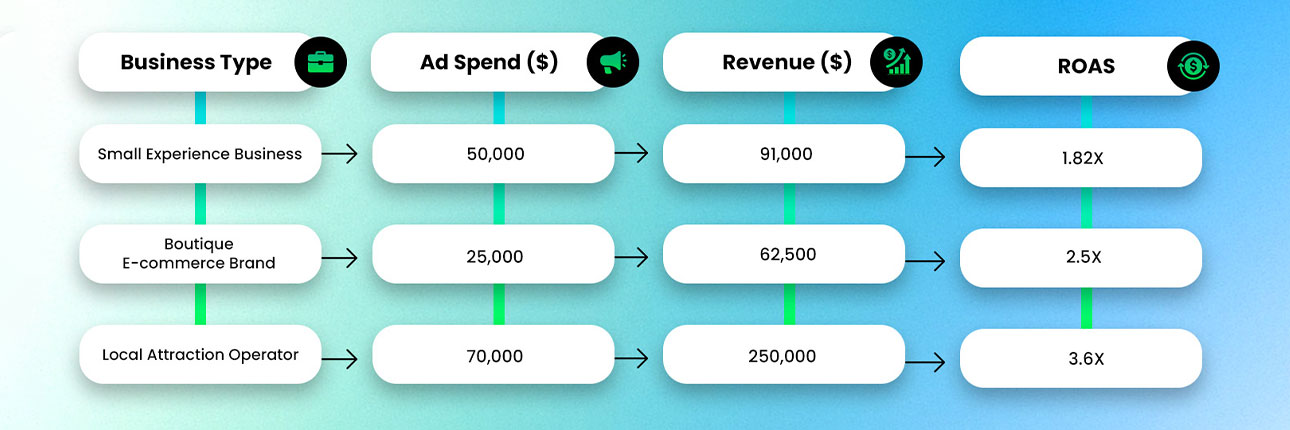
Numbers illustrate this best. Consider the following examples:
Each of these outcomes represents not only profitability but also the creation of first-party data assets, stronger customer relationships, and repeatable performance patterns. A ROAS in this range is not a sign of weakness; it is evidence of long-term viability.
The Long-Term ROI Equation
Short-term ROAS figures can be misleading if taken out of context. For businesses investing in direct digital campaigns, the first 6–12 months are often about building awareness, capturing audiences, and training ad algorithms.
During this phase, ROAS may start modestly. Over time, however, customer acquisition costs (CPA) typically decline while ROAS improves as campaigns optimize.
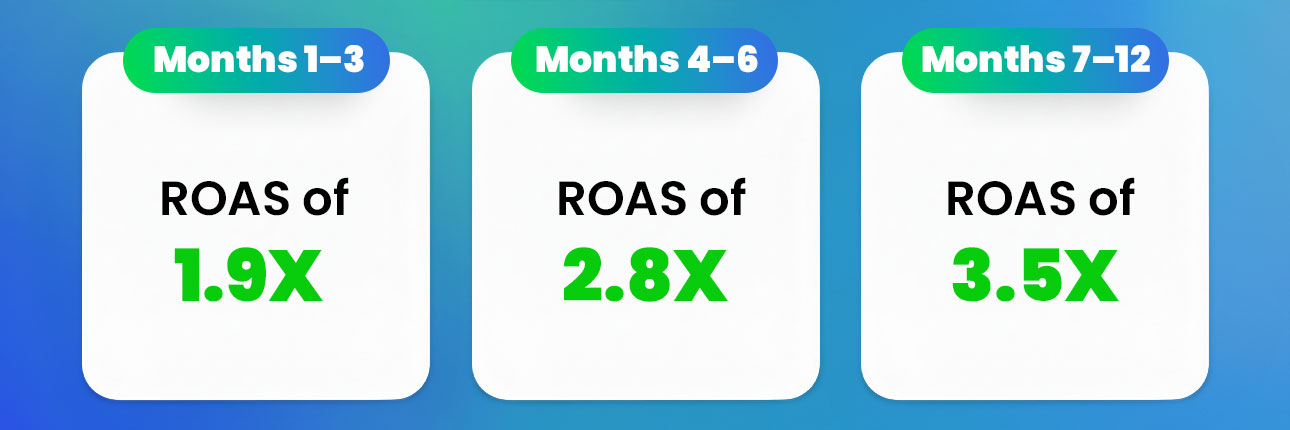
An example from a European regional experience company demonstrates this trajectory:
By the end of year one, the company reduced acquisition costs by 30%, doubled repeat bookings, and gained full ownership of its customer base. This progression highlights why a “lower” ROAS in early stages can still indicate healthy long-term growth.
Practical Strategies for Smaller Businesses
To compete effectively against larger players and to maximize ROAS, smaller businesses should adopt a holistic and data-driven approach:
Be present across multiple channels. Diversification reduces risk and expands reach.
Build first-party data early. Email sign-ups, loyalty programs, and CRM integrations are critical.
Leverage retargeting and lookalike audiences. These strategies stretch ad budgets further by focusing on high-potential customers.
Bundle and upsell. Increasing average order value boosts ROAS without requiring more ad spend.
Prioritize sustainable growth. Aim for gradual improvements rather than chasing quick, unsustainable wins.
Key Takeaways
A 1.87× to 3.6× ROAS is both healthy and realistic for small and mid-size businesses in 2025.
Benchmarks confirm that 2× to 3× is the typical range across travel, retail, and experiences.
Competing directly with aggregators is less effective than focusing on customer ownership and sustainable growth.
The ultimate goal is not to achieve the highest ROAS possible, but to create a repeatable, data-driven growth engine.
Conclusion
In today’s competitive landscape, the pursuit of “the highest ROAS” can be misleading. Instead, businesses should focus on sustainable performance that balances profitability with long-term customer ownership.
If your campaigns are consistently delivering a ROAS between 1.87× and 3.6×, you are not underachieving. You are building independence from aggregators, strengthening your margins, and creating a smarter foundation for scale.